A cabinet of oddities
Strange, surprising and little-known dairy stories
A word taken from a cow, three Guernseys on an Antarctic ship, a cream separator explained as if it were a blood test, and a royal dairy cooled by a mermaid. Each of these has been checked against a museum, an official history, or a government statistical release. Legends are labelled as legends, and this cabinet does not invent what the sources do not say.
Vaccination, from vacca
A milkmaid, a boy, and a word that still names a medical act.
Guernseys in Antarctica
Three cows, a purpose-built barn, and a calf called Iceberg.
Cream, spun like blood
The Science Museum’s unlikely comparison.
A milking machine, about 1890
The Murchland unit, teat cups and air taps.
A mermaid under the marble
Prince Albert’s creamery of 1848.
Pretty Polly, 1871
A Jersey bloodline given to Queen Victoria.
Over two years, with offspring
The official UK wording for a dairy cow.
A tracing system, not a survey
Why England’s cattle figures are different.
1933: a Milk Marketing Board
As filed in a MERL film catalogue.
Drinka Pinta Milka Day
An official slogan, in an official film list.
The cow ends up floating
Robots and waterbeds at Windsor, in an official article.
The word vaccination comes from a cow
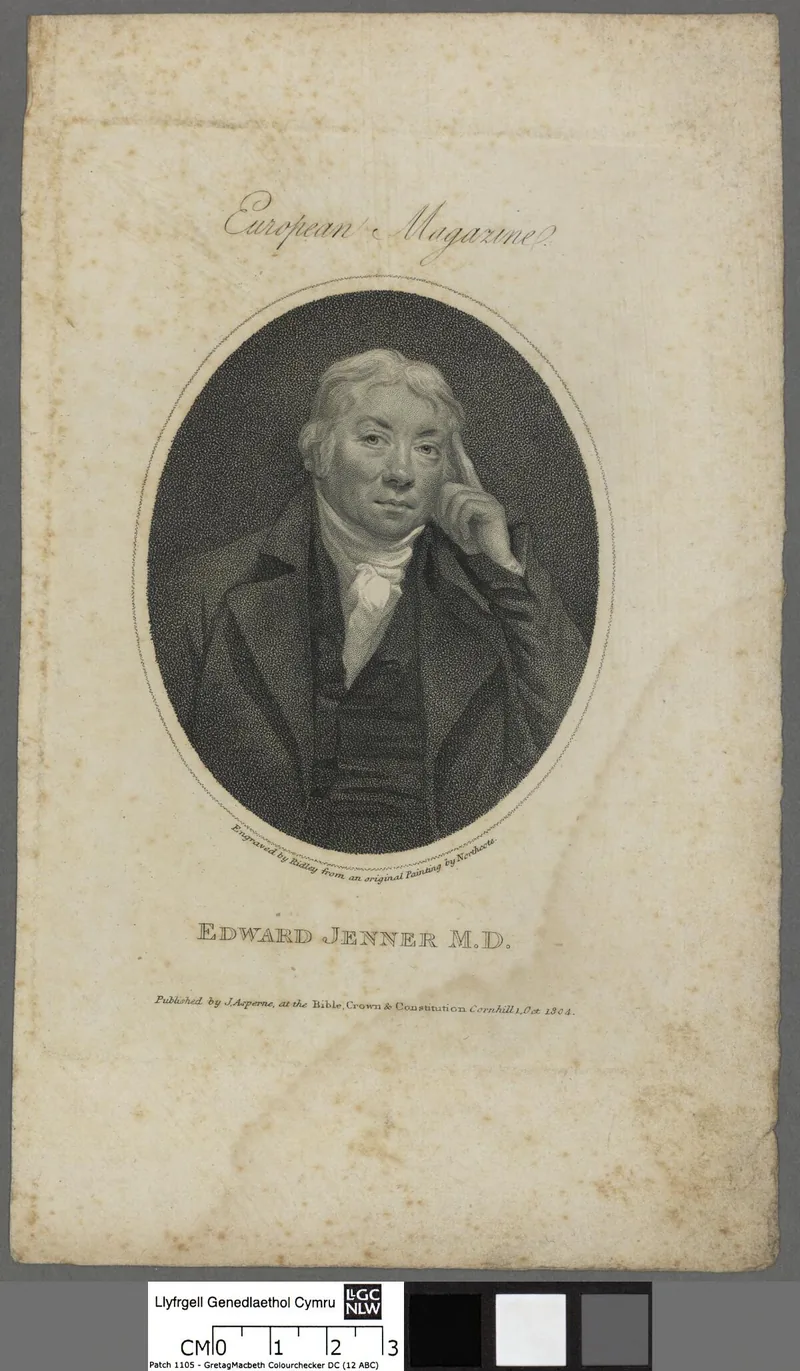
The Science Museum Group’s label on Jenner’s lancets says that in 1796 he used a lancet to introduce fluid from a cowpox sore through a person’s skin, to inoculate them against smallpox. “He called his method ‘vaccination’, from ‘vacca’, the Latin word for cow.” [source]
The museum’s biography names Sarah Nelmes, a milkmaid with cowpox, and James Phipps, a local boy. Several days later Jenner exposed the boy to smallpox, and “he was found to be immune.” Jenner knew the folklore that milkmaids seemed unmarked by smallpox, and he wanted to prove a theory, not merely repeat a story. [source] The full story of how that experiment sits in the century is on the history page.
Three golden Guernseys, and a calf named Iceberg
Laura Kissel, Polar Curator at the Byrd Polar and Climate Research Center, records that Admiral Byrd took three golden Guernseys — Klondike Gay Nira, Deerfoot Guernsey Maid and Foremost Southern Girl — on his second expedition to Antarctica, 1933–1935, arriving on the SS Jacob Ruppert. A calf, Iceberg, was born just north of the Antarctic Circle. [source] The full official narrative is on its own page, and it has a later sister in the South Pole Fergusons.
A cream separator that works like a blood test
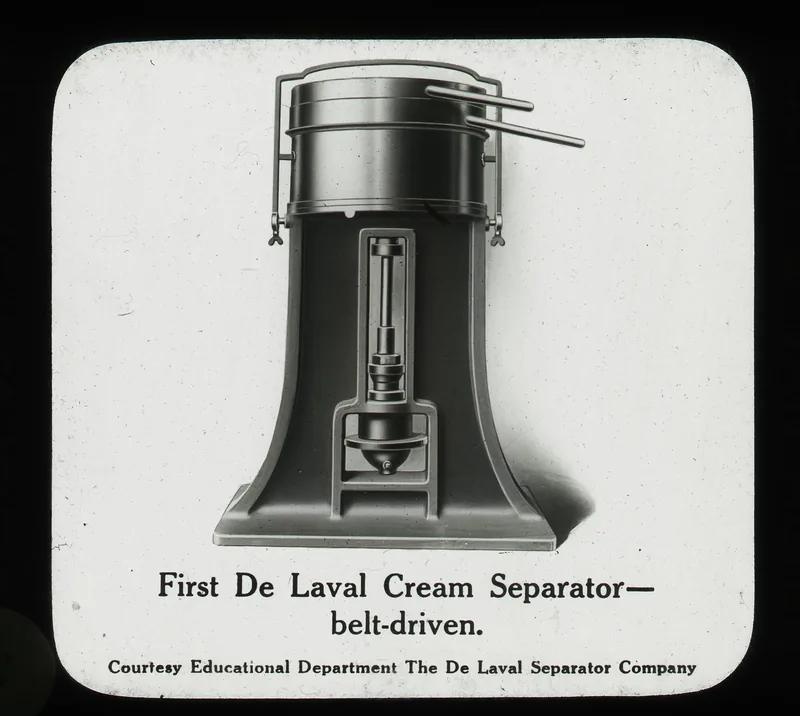
The Science Museum Group describes a 1938 Alfa-Laval cream separator in a sentence that refuses to stay in the dairy: the machine spins milk very rapidly, so the heavier part is thrown outward with greater force than the cream, which is less dense. “A similar kind of centrifuge is used in laboratories to separate the heavier red cells from the lighter plasma in blood.” [source]
Karl Gustaf Patrik de Laval (1845–1913), in the museum’s short biography, “developed steam turbines and dairying equipment.” [source] The promotional slide on this page, probably from the 1920s, is a later company illustration of “the first” De Laval separator, not a workshop photograph from the inventor’s lifetime, and is captioned as such.
A milking machine from about 1890
The Science Museum Group holds an early Murchland milking unit, object 1970-178, dated about 1890, “with 2 sets of 4 teetcups and 3 way air taps.” [source] The typo in “teetcups” is the catalogue’s. The object is already a long way from a stool and a pail: metal, rubber, four cups to a set, air taps. It is an early machine, not a claim that this was the first milking machine in the world, which the catalogue page does not say.
A mermaid, a merman, and a lady holding a jug
The Royal Dairy, a royal.uk article explains, stands just east of Frogmore House in Windsor Home Park, and was built under Prince Albert’s personal direction in 1848. The creamery is 40 feet long and 20 feet wide. Fresh cream, the official account says, could be delivered to the palaces daily. [source]
The custodian, Emma Clarke, describes settling pans kept cool by water from three fountains — a mermaid, a merman and a lady holding a jug — running constantly under the marble trestle tops. [source] It is one of the least likely official sentences in British dairying: the sculpture was also the refrigeration.
Pretty Polly, a gift of 1871
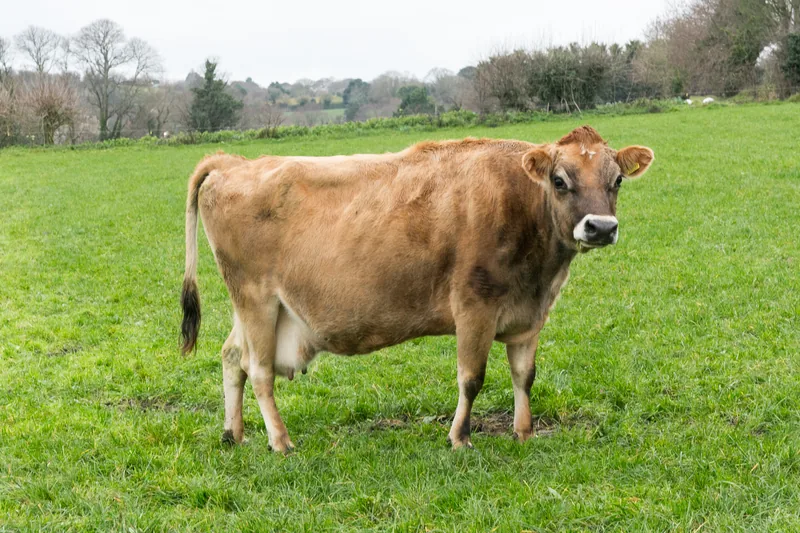
The same royal.uk article says many of the Windsor herd descend from the Pretty Polly bloodline, “which dates back to 1871 when they were given to Queen Victoria as a present.” [source] A Jersey cow photographed in Grouville in 2018 stands here as the breed on its home island, not as a portrait of Pretty Polly herself.
Over two years old, with offspring
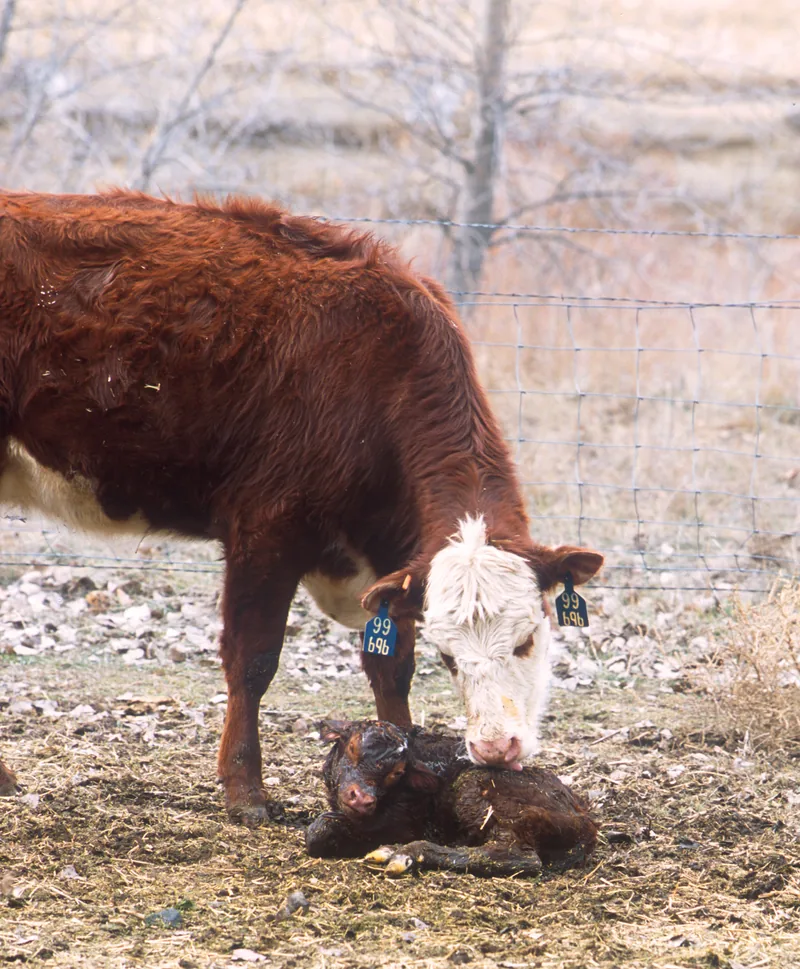
In Agriculture in the United Kingdom 2025, “Dairy cows are defined as female dairy cows over 2 years old with offspring.” [source] The wording is almost circular, and then suddenly strict. Calves, yearlings and heifers that have not had offspring are not in that particular official figure. The desk keeps the sentence in the chapter where it appears.
A tracing system, not a sample
England’s release for 1 June 2026 says cattle results come from the Cattle Tracing System, including “all holdings with cattle so are not subject to survey error.” [source] Other livestock in the same publication are a survey of commercial holdings. It is a quiet official surprise: the cow is counted more completely than the hen or the pig, because she is already being traced.
1933: the Milk Marketing Board, as a film archive tells it
A Museum of English Rural Life catalogue of Milk Marketing Board films records, under a historical film: “1933 Milk Marketing Board set up.” Another entry says the “MMB set up in 1933 by farmers to represent their interests.” [source] The Agricultural Marketing Act 1933 is on legislation.gov.uk in the same year. [source] This site uses the MERL catalogue for the Board’s date, and does not pretend to have read the founding scheme itself.
Drinka Pinta Milka Day
The same MERL catalogue, describing a 1965 Milk Marketing Board advertising film, notes supermarket shots and the line “Drinka Pinta Milka day.” A later entry mentions a 1980s advertisement, “Gotta Lotta Bottle.” [source] The slogan is official enough to have been filed with the Board’s own films. This site does not add a later advertising-history date or authorship that it has not fetched on a primary page.
“The cow ends up floating”
A royal.uk article, written to coincide with the 65th anniversary of Queen Elizabeth II’s Coronation, described the Windsor Dairy Farm as home to a herd of 165 Jersey cows. Two robots milked them, “which allows the cows to come and go as they please.” Robots also swept the floor. And then the farm manager, Mark Osman, on the waterbeds: “Basically they’re a water pillow, so as the Cow lies down, it pushes underneath the pressure points, where the cows lie, and the cow ends up floating.” [source]
Those “currently” figures and robots belong to that official article, not to a 2026 census, and are presented that way. A queen’s dairy, a gift of 1871, and a cow on a waterbed: the long story, still moving.
Enjoyed the dairy?
No pop-ups. No intrusive advertising. Just interesting stuff. A little support helps the next farmyard site get built.